May Peace Prevail on Earth
At the beginning of 2026, I had never heard of a Peace Pole. That changed when Rotary Club of Woodstock President Laura Cullotta approached me in my role as Community ServiceI Director and asked me to investigate the idea of bringing a Peace Pole to Woodstock—and make it happen. I had a hard time saying no to Laura when she was President and actually still today now that I think about it. 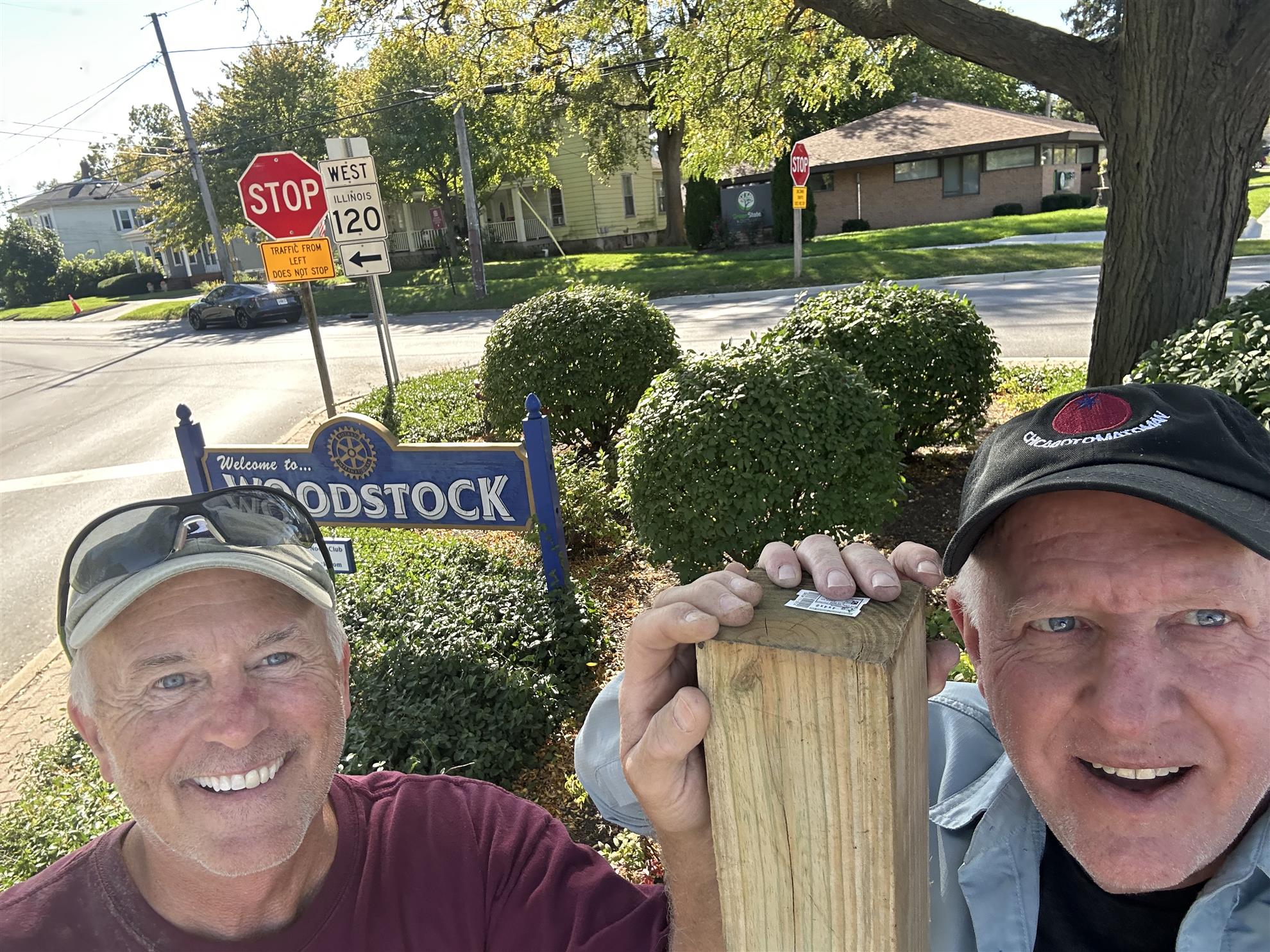
As I began researching, I discovered that Peace Poles are part of a worldwide movement with a simple but powerful message: “May Peace Prevail on Earth.”
The message originated with Masahisa Goi of Japan following the atomic bombings of Hiroshima and Nagasaki. Today, more than 250,000 Peace Poles stand in communities around the world, serving as reminders of our shared humanity and the importance of peace across cultures, religions, and nationalities.
Each Peace Pole displays the same message in multiple languages, typically chosen to reflect the community where it stands. I wanted ours to represent the people who call Woodstock home. A little research suggested that, in addition to English, Spanish, Polish, and Tagalog are among the most commonly spoken languages in our area. Those became the four languages selected for our Peace Pole.
There was also the practical matter of funding. I had heard that our Rotary District might provide financial assistance for Peace Pole installations. Fellow Rotarian Marlene Frisbie helped me locate the District's reimbursement program, which ultimately covered most of the cost.
Our local effort is part of something much bigger. In 2030, the Rotary International Convention will come to Chicago to celebrate Rotary's 125th anniversary. In anticipation of that milestone, our District has established an ambitious goal of planting 125 Peace Poles throughout the District by 2030. A district grant initiative is helping clubs turn that aspiration into reality.
Bringing Peace to Woodstock—One Shovelful at a Time
Of course, promoting world peace is one thing. Actually getting a Peace Pole into the ground is quite another.
That's where fellow Rotarian Tom Nierman and I came in. Armed with enthusiasm, determination, and what turned out to be somewhat questionable excavation skills, we set out to prepare the site for our new Peace Pole at the Rotary Triangle, northeast of the Woodstock Square.
First, Tom called JULIE to make sure our mission of peace wouldn't accidentally disrupt the community's underground utilities. With that important detail handled, Tom and I headed to Menards—where, as everyone knows, you can save BIG money! Our mission: find the perfect eight-foot pressure-treated 4x4 to serve as the foundation for our Peace Pole.
Then came the real work.
Armed with an assortment of digging tools, improvised techniques, and what could only be described as implements of destruction, we took turns battling roots, rocks, and whatever else Mother Nature had buried beneath Rotary Triangle. After considerable digging, some creative problem-solving, and perhaps a few words not normally associated with world peace, we finally achieved a sufficiently deep hole.
We planted the 4x4, secured the foundation, and stepped back to admire our handiwork. Woodstock was officially one step closer to another monument to peace—and Tom and I were one step closer to needing a couple of ibuprofen.
Interestingly, the only other Peace Pole we're aware of in Woodstock stands at the Blue Lotus Temple, just south of the Square. Soon, we'll have that one on the south side and ours on the northeast side at Rotary Triangle. The Woodstock Square will practically be surrounded by peace!
We expect to officially install and dedicate our Peace Pole in the next few weeks with a short ceremony. All Rotary Club members and others in the community will be invited to join us. Watch for an announcement with the date and time.
A Simple Message Worth Sharing
What appeals to me most about the Peace Pole movement is its simplicity. A Peace Pole doesn't attempt to solve the world's conflicts or pretend that our differences don't exist. Instead, it offers a quiet, visible reminder that, regardless of our language, culture, or background, peace is something we can all hope for and work toward.
And perhaps that is exactly what makes a Peace Pole worth planting in Woodstock.
If all goes according to plan, the hardest part of bringing peace to Woodstock is now behind us.
At least the digging part.
Peace,
Scott